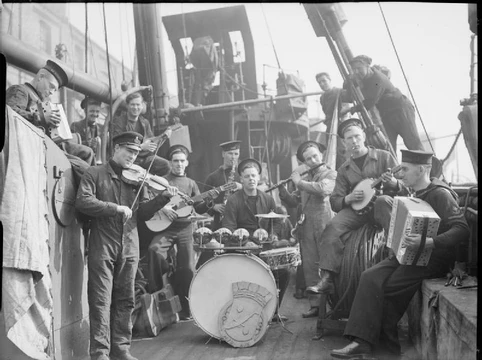
Away in a Manger
Christmas carol of disputed origin, widely sung in English-speaking world.
"Away in a Manger" first appeared in print near the end of the 1800s and has since become a widely sung Christmas carol across the English-speaking world. In the United Kingdom, a 1996 Gallup Poll placed it as the second most popular carol, tied with another. For many years, people believed the German reformer Martin Luther had written it, but scholars now agree it likely originated entirely in the United States. The two most common tunes used for the carol were composed by William J. Kirkpatrick in 1895 and James Ramsey Murray in 1887.
- First published
- late nineteenth century
- Most common musical settings
- William J. Kirkpatrick (1895) and James Ramsey Murray (1887)
- Original attribution
- Martin Luther (now considered spurious)
- First known appearance of words
- 2 March 1882, in The Christian Cynosure
- First known appearance of third verse
- 1892, in Gabriel's Vineyard Songs
- Popularity ranking (UK, 1996)
- joint second in Gallup Poll
Lore & Background
The carol's words first appeared on 2 March 1882 in the "Childrens' Corner" section of the anti-Masonic journal The Christian Cynosure, under the heading "Luther's Cradle Song". An anonymous author contributed the first two verses, claiming the hymn was composed by Martin Luther for his children and still sung by German mothers. Near-identical articles appeared in The Sailors' Magazine and Seamen's Friend (November 1883) and Little Pilgrim Songs (preface dated 10 November 1883). The May 1884 issue of The Myrtle also included the carol with a similar attribution to Luther.
The third stanza, "Be near me, Lord Jesus", is absent from early sources. Its first known appearance was in Gabriel's Vineyard Songs (1892), set to a melody by Charles H. Gabriel. Decades later, a story attributed the third verse to John T. MacFarland, but since that story dates the stanza to 1904–1908—over a decade after its first known appearance—the claim is considered suspect. It has been suggested that Gabriel may have written the third stanza himself.
The carol's early popularity is reflected in a report from an American mission in Maharashtra, India (published 1885, covering 1884), stating that Luther's cradle hymn was a favorite. By 1891, the carol was sweeping the United States, with at least four musical settings published that year.
Reader's Guide
The significance of "Away in a Manger" lies in its widespread adoption as a Christmas carol across the English-speaking world, despite its obscure origins and the now-rejected attribution to Martin Luther. The carol's history illustrates how popular religious music can acquire spurious authorship claims that persist for decades. The two most common musical settings—by William J. Kirkpatrick (1895) and James Ramsey Murray (1887)—have shaped the carol's identity, with Murray's melody becoming known as "Mueller" after an erroneous attribution to a "Carl Mueller." The carol's many textual variants, documented from the earliest publications, show how oral and printed transmission can produce numerous versions of a simple hymn. The third stanza, added later and of uncertain authorship, became a standard part of the carol. The carol's legacy includes its ranking as joint second in a 1996 British Gallup Poll, its use in Sunday School celebrations as early as 1883, and its spread to mission contexts in India by 1884. The carol remains a staple of Christmas repertoire, its true origins still debated.
Did You Know?
- The carol was first published in the late nineteenth century and is now thought to be wholly American in origin, not German as long claimed.
- The earliest known appearance of the words was on 2 March 1882 in the anti-Masonic journal The Christian Cynosure.
- The third stanza first appeared in 1892 in Gabriel's Vineyard Songs, over a decade before a later story attributed it to John T. MacFarland.
- The melody by James Ramsey Murray (1887) was later misattributed to a 'Carl Mueller', whose identity is unknown.
More in Songs & Compositions 1-22
Spotted an error? Know more?
This is a living reference — every entry is fact-audited, and reader corrections feed straight into our audit queue. Suggest an edit · See this site's audit record